The workplace transformation is not coming; it’s already here. With 170 million new jobs projected to be created by 2030 according to the World Economic Forum’s latest Future of Jobs Report, while 92 million roles are simultaneously displaced, we’re witnessing the most dramatic reshaping of the global labor market in modern history.
The rise of artificial intelligence, from generative AI tools like ChatGPT to advanced automation systems, is fundamentally altering how we work, what we do, and which skills matter most.
Yet this disruption brings unprecedented opportunity. The key insight driving successful careers in this new era?
The goal is not to compete with AI, but to develop skills to collaborate with it effectively. This means cultivating a strategic combination of uniquely human capabilities, critical thinking, creativity, and emotional intelligence, alongside technical proficiencies in data literacy, AI fluency, and adaptive learning. Success belongs to those who can seamlessly blend human insight with artificial intelligence capabilities.
In this comprehensive guide, we’ll explore three essential categories of skills for thriving in the AI-driven workforce: the quintessential human skills that AI cannot replicate, the technical and strategic competencies needed to steer AI tools effectively, and a practical framework for creating your personal future-proofing plan.
1. The Quintessential Human Skills AI Can’t Replicate
1.1 Critical Thinking & Complex Problem-Solving
What it means: Critical thinking involves analyzing information objectively, questioning assumptions, evaluating evidence, and drawing reasoned conclusions. In an AI context, it’s the ability to interrogate AI outputs, understand their limitations, and apply human judgment to complex, nuanced situations.
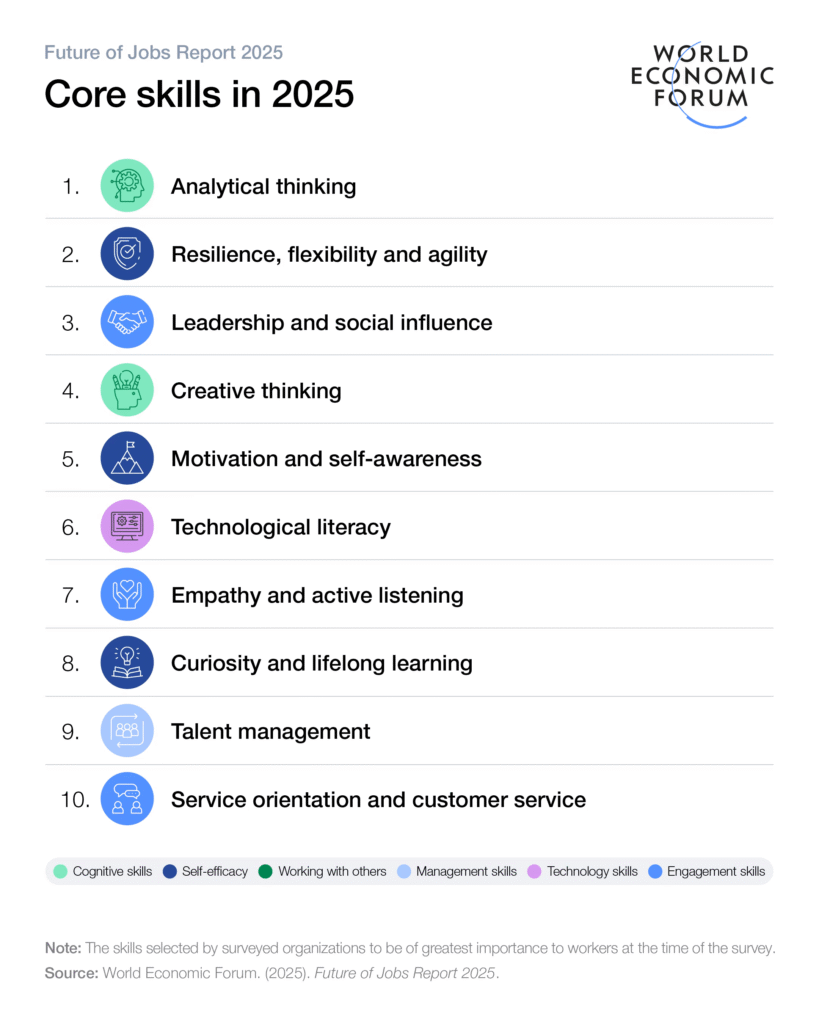
Why it’s crucial in an AI-powered workplace: According to the World Economic Forum’s 2025 report, analytical thinking remains the most sought-after core skill among employers, with seven out of 10 companies considering it essential. While AI excels at processing vast amounts of data, it cannot replicate the human ability to understand context, navigate ambiguity, or make ethical judgments in complex scenarios.
Real-world example: Consider a business strategist using AI to research market trends for a new product launch. The AI provides comprehensive data on consumer behavior, competitor analysis, and market projections. However, the strategist must critically evaluate this information, question potential biases in the data sources, consider cultural nuances the AI might miss, and weigh ethical implications of different marketing approaches. The AI serves as a powerful research assistant, but human critical thinking drives the strategic decision-making.
Actionable tips for development:
• Practice the “5 Whys” technique: When presented with AI-generated insights, ask “why” five consecutive times to dig deeper into underlying assumptions and causations.
• Seek diverse perspectives: Regularly engage with colleagues from different departments, backgrounds, and industries to challenge your thinking patterns and broaden your analytical frameworks.
• Develop source evaluation skills: Train yourself to assess the credibility, bias, and limitations of information sources, whether human-generated or AI-produced.
1.2 Creativity & Innovation
What it means: Creativity in the AI era isn’t just about artistic expression—it’s about generating novel solutions, combining ideas in unexpected ways, and applying imaginative thinking to solve complex problems. It’s the uniquely human ability to conceptualize possibilities that don’t yet exist.
Why it’s crucial in an AI-powered workplace: McKinsey’s research indicates that creativity is expected to see a potential increase of 12 percent in demand by 2030. While generative AI can produce variations on existing content, it cannot truly innovate or create breakthrough concepts that require intuitive leaps, cultural understanding, or emotional resonance.
Real-world example: A marketing director uses AI to generate initial campaign concepts based on successful past campaigns and current trends. The AI produces dozens of variations, providing a rich foundation of ideas. However, the human marketer takes these concepts and applies creative thinking to develop a unique campaign that combines unexpected elements, perhaps linking the product to an emerging social movement or creating an innovative storytelling approach that resonates with the target audience’s deeper values and aspirations.
Actionable tips for development:
• Embrace structured creativity techniques: Learn methods like SCAMPER (Substitute, Combine, Adapt, Modify, Put to other uses, Eliminate, Reverse) to systematically explore creative possibilities when working with AI-generated content.
• Cross-pollinate ideas regularly: Deliberately expose yourself to industries, cultures, and disciplines outside your expertise. Attend conferences in different fields, read publications from unrelated sectors, and engage with diverse communities.
• Practice constraint-based creativity: Set artificial limitations when brainstorming (e.g., “solve this problem using only sustainable materials” or “design this solution for users with no internet access”) to force innovative thinking beyond conventional approaches.
1.3 Emotional & Social Intelligence
What it means: Emotional intelligence encompasses self-awareness, self-regulation, empathy, and social skills. It’s the ability to understand and manage your own emotions while effectively navigating interpersonal relationships and group dynamics.
Why it’s crucial in an AI-powered workplace: According to McKinsey’s analysis, demand for social and emotional skills could rise by 11 percent in Europe and 14 percent in the United States by 2030. As AI handles more routine tasks, human work increasingly centers on collaboration, leadership, and relationship-building; areas where emotional intelligence is paramount.
Real-world example: A team leader manages a hybrid workforce where AI tools handle project scheduling, resource allocation, and progress tracking. However, when team members express anxiety about AI potentially replacing their roles, the leader’s emotional intelligence becomes critical. They recognize the underlying fears, facilitate open discussions about the team’s concerns, help individuals identify their unique value propositions, and foster psychological safety that enables productive human-AI collaboration.
Actionable tips for development:
• Practice active listening with AI augmentation: Use sentiment analysis tools to track emotional patterns in team communications, but rely on your emotional intelligence to interpret what these patterns mean and how to respond appropriately.
• Develop cultural intelligence: As AI enables more global collaboration, strengthen your ability to navigate cultural differences, understand diverse communication styles, and build trust across cultural boundaries.
• Master the art of feedback: Learn to give and receive constructive feedback in environments where AI provides performance data. Focus on the human elements; motivation, growth mindset, and emotional support; that data alone cannot address.
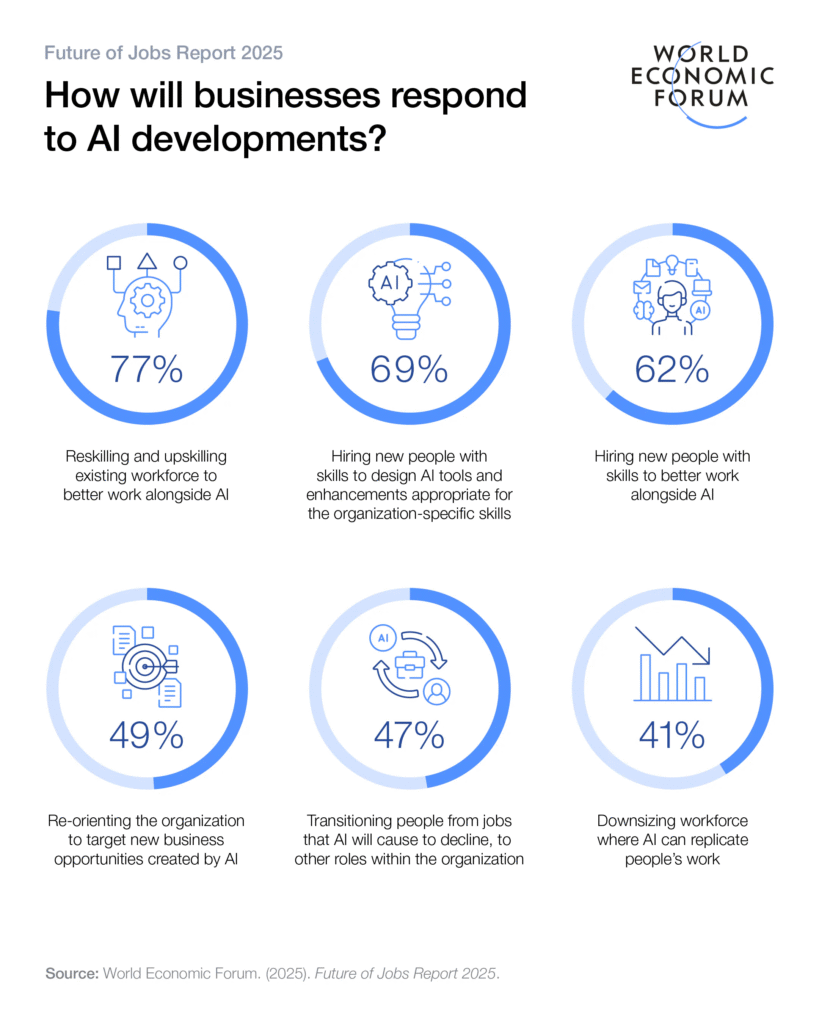
2. The Technical & Strategic Skills to Steer the Ship
2.1 Data Literacy & AI Proficiency
What it means: Data literacy is the ability to read, understand, create, and communicate data effectively. Combined with AI proficiency, it involves understanding how AI systems work, interpreting their outputs, recognizing their limitations, and using them as strategic tools for decision-making.
Why it’s crucial in an AI-powered workplace: The World Economic Forum identifies AI and big data as the top fastest-growing skills, with networks and cybersecurity and technological literacy following closely. Organizations report that 63% of employers cite skills gaps as the biggest barrier to business transformation, with data and AI competencies at the forefront of these needs.
Real-world example: A marketing manager uses an AI-powered analytics dashboard that predicts customer lifetime value and recommends budget allocation across different channels. Rather than blindly following the AI’s recommendations, the data-literate manager examines the underlying data sources, understands the model’s assumptions, recognizes potential biases (such as historical data that may not reflect current market conditions), and combines the AI insights with qualitative market knowledge to make informed budget decisions.
Actionable tips for development:
• Start with data storytelling: Learn to translate complex data visualizations and AI outputs into compelling narratives that non-technical stakeholders can understand and act upon.
• Understand AI model basics: You don’t need to become a data scientist, but learn fundamental concepts like training data, algorithms, confidence levels, and common sources of bias in AI systems.
• Practice prompt engineering: Develop expertise in crafting effective prompts for AI tools. This skill, highlighted in Harvard Business Review research, involves using research-backed techniques to get better results from AI systems.
2.2 Adaptability & Lifelong Learning
What it means: Adaptability is the capacity to adjust quickly to new conditions, technologies, and ways of working. Lifelong learning involves continuously acquiring new knowledge and skills throughout your career, staying curious, and maintaining a growth mindset in the face of constant change.
Why it’s crucial in an AI-powered workplace: The World Economic Forum reports that 39% of existing skill sets will be transformed or become outdated by 2030. The pace of technological change means that the half-life of specific technical skills is shrinking rapidly. Resilience, flexibility, and agility rank among the most important skills differentiating growing from declining job roles.
Real-world example: A graphic designer initially viewed AI image generation tools as a threat to their profession. However, by embracing adaptability, they learned to use these tools to enhance their creative process—using AI for rapid ideation and preliminary concepts while focusing their human expertise on strategic design thinking, client consultation, and final creative refinement. They continuously upskill through online courses, experimenting with new AI tools, and developing expertise in prompt-based design workflows.
Actionable tips for development:
• Adopt a “learn-do-teach” cycle: Regularly acquire new skills, immediately apply them in real projects, and then teach others what you’ve learned. This reinforces learning and positions you as a knowledge leader.
• Build a personal learning network: Cultivate relationships with colleagues, industry experts, and online communities who can alert you to emerging trends and learning opportunities.
• Practice micro-learning: According to research on effective upskilling strategies, dedicate 15-30 minutes daily to learning something new rather than waiting for formal training opportunities.
2.3 AI Ethics & Governance
What it means: AI ethics and governance involve understanding the responsible development and deployment of AI systems, ensuring fairness, transparency, and accountability in AI-driven decisions, and navigating the complex ethical considerations that arise when humans and machines collaborate.
Why it’s crucial in an AI-powered workplace: As IBM research shows, 80 percent of businesses are concerned about adopting AI technology without effective governance structures and ethical considerations in place. McKinsey reports that 13 percent of organizations have hired AI compliance specialists, and 6 percent have hired AI ethics specialists, new roles that didn’t exist five years ago.
Real-world example: An HR professional developing company policy on using AI in hiring processes must navigate complex ethical terrain. They need to understand how AI hiring tools can perpetuate bias, ensure compliance with emerging regulations like the EU AI Act, establish transparent processes for candidates who are evaluated by AI systems, and create oversight mechanisms that maintain human accountability in hiring decisions.
Actionable tips for development:
• Study real AI ethics cases: Regularly examine case studies of AI failures or ethical dilemmas in your industry to understand practical implications and develop judgment for similar situations.
• Learn regulatory frameworks: Familiarize yourself with emerging AI regulations in your jurisdiction, such as the EU AI Act, and understand how they apply to your role and industry.
• Develop cross-functional collaboration skills: AI governance requires working with legal, technical, and business stakeholders. Practice translating ethical concerns into business language and technical requirements.
The future of work is not a distant possibility; it’s unfolding now. The World Economic Forum’s projection of 78 million net new jobs by 2030 represents more than statistics; it represents opportunities for those who prepare strategically. The formula for success in this AI-driven landscape combines two essential elements: mastering uniquely human capabilities that complement rather than compete with artificial intelligence, and developing the technical fluency to leverage AI as a powerful collaborative tool.
The professionals who will thrive are those who embrace this fundamental truth: artificial intelligence amplifies human potential rather than replacing it. Your critical thinking guides AI research toward meaningful insights. Your creativity transforms AI-generated concepts into breakthrough innovations. Your emotional intelligence ensures that technological advancement serves human flourishing. Your data literacy enables you to steer AI tools toward strategic objectives. Your adaptability allows you to evolve alongside rapidly advancing technologies.
The choice before us is not whether AI will reshape our careers; that transformation is already underway. The choice is whether we will actively shape our professional futures or passively respond to change. The time for preparation is now.
Every day you invest in developing these essential skills is a day you move closer to not just surviving but thriving in the AI-driven workforce of tomorrow.
Begin today. Your future self; and your career; depend on the actions you take TODAY.
Fin.