
Essential Soft Skills for Technology Professionals
In an era marked by rapid technological advancement and increasingly complex workplace dynamics, soft skills have emerged as pivotal determinants of both individual career progression and organizational success.
What Are Soft Skills?
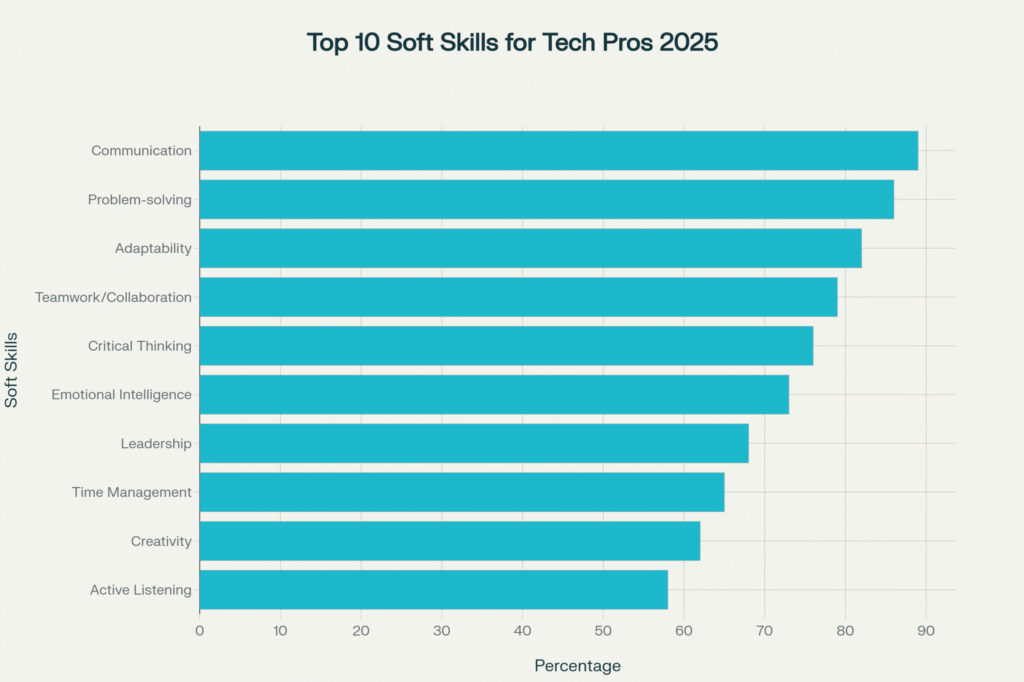
Soft skills are personal and social abilities that help people work effectively in any environment.
They include communication, teamwork, problem-solving, adaptability, empathy, creativity, and time management.
Unlike technical skills, soft skills focus on how we interact, collaborate, and adapt, both with people and new situations.
Examples:
- Explaining a technical problem in simple terms so all teammates can follow.
- Adapting quickly when a project deadline changes.
- Listening to feedback and responding constructively.
In modern tech workplaces, soft skills bridge the gap between technical expertise and successful human interactions.
Why Are Soft Skills More Relevant Than Ever?
Technology keeps changing fast.
Jobs are more remote and projects more complex, making soft skills the glue that connects teams, clients, and solutions.
Over 90% of top performers in the workplace have strong soft skills, especially emotional intelligence. Technical know-how is not enough; communication, empathy, and adaptability help manage change and lead teams through uncertainty.
Employers say foundational skills like teamwork and problem-solving, are key to moving up in a career. Soft skills make professionals resilient to industry disruption and able to climb the career ladder.
Why Do Techies Need to Build This Out?
Tech professionals often work in cross-functional teams or interact with clients who may not be tech-savvy.
Projects succeed when everyone can share ideas clearly, listen well, resolve conflicts, and handle feedback.
Strong soft skills turn technical solutions into team results, helping build and maintain trust with colleagues and stakeholders.
Examples:
- A project manager using time management and clear communication ensures deadlines are met.
- A software engineer showing empathy when training junior team members creates a positive learning environment.
Without these abilities, even skilled workers struggle to lead, influence, and create impact at work.
How Do Cultures Play a Role in This?
Culture shapes which soft skills are valued and how they’re taught, rooted in centuries of history.
India
Hierarchical traditions from the caste system and colonial times foster respect for authority, but globalization pushes Indian professionals to master cross-cultural communication.
IT giants in Bangalore and Hyderabad invest in global client training, blending tradition with international expectations.
Silicon Valley, USA
A culture of risk-taking, direct communication, and innovation evolved from entrepreneurial histories and academic influences. This encourages open feedback and leadership at every level.
Europe
Consensus-building and work-life balance come from social democratic traditions and group decision-making. Companies create collaborative, inclusive environments, focusing on teamwork and diversity.
East Asia
Confucian values emphasize social harmony and collective responsibility. Teamwork and continuous learning are central, reflecting centuries of prioritizing group achievement over individual goals.
Remote/Global Teams
Digital-first and post-pandemic cultures prioritize clear online communication and cultural awareness.
Professionals must adapt their soft skills for global collaboration, bridging differences and time zones.
How Can One Get Better at Soft Skills?
Improvement is practical and achievable.
- Join workshops simulating scenarios like team meetings, client calls, or conflict resolution.
- Seek mentorship and regular feedback from colleagues and managers.
- Use digital micro-learning platforms for on-demand lessons on listening, time management, and empathy.
- Track growth via peer reviews or assessments tied to soft skills.
Consistent practice, such as soliciting feedback after meetings or reflecting daily on interactions, builds these skills effectively.
Examples: Applying Major Soft Skills in Real Situations
Communication
A developer explaining a system bug to a non-technical client uses simple language and visual diagrams to ensure understanding. This avoids miscommunication and sets clear expectations.
During virtual team meetings, active listening and asking clarifying questions help remote teams stay aligned.
Teamwork
On a software release, team members share knowledge openly, offer help when peers are blocked, and celebrate each milestone together, creating a cooperative spirit.
Conflict arises when two developers disagree on a solution; they hold a constructive discussion to weigh pros and cons, leading to a better combined approach.
Problem-Solving
A tech lead quickly analyzes a system failure under tight deadlines, involves the right specialists, and devises a workaround until a permanent fix can be implemented.
Continuous improvement meetings encourage identifying recurring issues and brainstorming preventive measures.
Adaptability
A project deadline shifts due to market conditions; the team reorganizes tasks and priorities without losing momentum.
A developer learns a new programming framework mid-project to meet client needs, showing growth mindset.
Emotional Intelligence
During a performance review, a manager notices a lack of motivation in a team member, listens empathetically, and discusses career goals to provide support.
When receiving criticism, a junior engineer remains open-minded, asking for examples and suggestions to improve.
Leadership
A lead volunteer coordinates cross-department efforts during a company hackathon, encouraging innovation while ensuring everyone’s ideas are heard.
Mentoring juniors, providing positive feedback, and fostering confidence in team members build future leaders.
Time Management
A product owner breaks down large workflows into smaller, manageable sprints, ensuring steady delivery and avoiding burnout.
An individual uses prioritization tools (e.g., Eisenhower Matrix) to focus on critical tasks amidst distractions.
Creativity
Designers prototype multiple user interfaces, encouraging experimental thinking to discover innovative solutions beyond traditional standards.
Brainstorm sessions involve lateral thinking exercises to spark new ideas within tight constraints.
Conclusion
Soft skills clearly differentiate outstanding technology professionals today.
They enable clearer communication, better collaboration, faster problem-solving, and stronger leadership.
Cultural context influences which skills matter most, but the ability to develop and adapt these skills is universal.
Investing time and effort into soft skills means long-term career resilience and greater impact in a rapidly changing workplace.
Practicing these skills daily and embracing feedback can transform any technical expert into a valued team leader and influencer.
Sources
[1] The Power of Soft Skills in Tech-Driven Workplace https://www.apollotechnical.com/the-power-of-soft-skills-in-tech-driven-workplace/
[2] 30 Top Soft Skills Examples to Master in 2025 https://www.talentlms.com/blog/top-soft-skills-training-for-employees/
[3] What Are Soft Skills: Definitions and Examples https://in.indeed.com/career-advice/resumes-cover-letters/soft-skills
[4] Soft Skills: Definitions, Importance, and Examples [ 2025 ] https://www.foundit.in/career-advice/what-is-soft-skills/
[5] Soft Skills: Essential for the Future Workforce’s Success in … https://www.compunnel.com/blogs/why-soft-skills-are-crucial-for-success-in-2025-the-new-hard-skills-for-the-future-workforce/
[6] Soft Skills Matter Now More Than Ever, According to New … https://hbr.org/2025/08/soft-skills-matter-now-more-than-ever-according-to-new-research
[7] The top soft skills IT professionals need to have in 2025 https://www.pluralsight.com/resources/blog/upskilling/top-soft-skills-tech-2025
[8] IT Soft Skills: Definitions and Strategies for Development https://in.indeed.com/career-advice/career-development/it-soft-skills
[9] Soft Skills Development in the Digital Age https://www.promptpersonnel.com/soft-skills-development-in-the-digital-age-strategies-for-the-modern-workforce/
[10] Soft Skills: The missing piece in employability – Hindustan Times https://www.hindustantimes.com/education/features/soft-skills-the-missing-piece-in-employability-101731491841529.html
[11] why your organisation needs to develop soft skills | British Council https://corporate.britishcouncil.org/insights/why-your-organisation-needs-develop-soft-skills
[12] The Soft Skills Disconnect https://www.nationalsoftskills.org/the-soft-skills-disconnect/
[13] The Impact of Soft Skills on Workplace Success – LinkedIn https://www.linkedin.com/pulse/impact-soft-skills-workplace-success-bundle-skills-zki9c
[14] Telangana Innovation Cell https://teamtsic.telangana.gov.in
[15] Training institute in Bangalore http://www.ktmtech.in
[16] Be Practical Tech Solutions | Top Software Training Institute in Bangalore | Data Science | Cloud Computing | MERN https://be-practical.com
[17] Pumo Technovation- Software Training Institute in Bangalore – Full Stack Developer, Java, Python,AWS, Data Science,Web Design https://www.pumotechnovation.com
[18] Gaea Global Technologies, India, Bangalore http://gaeaglobal.com
[19] Top 7 In-Demand Tech Skills for 2025 – NetTech India https://www.nettechindia.com/blog/top-7-in-demand-tech-skills-for-2025/
[20] 5 Important Soft Skills You Must Know to Boost Your Career https://www.promptpersonnel.com/5-important-soft-skills-you-must-know-to-boost-your-career/
[21] The Top Skills Employers Seek Have Nothing to Do With Technology https://professional.dce.harvard.edu/blog/the-top-skills-employers-seek-have-nothing-to-do-with-technology/